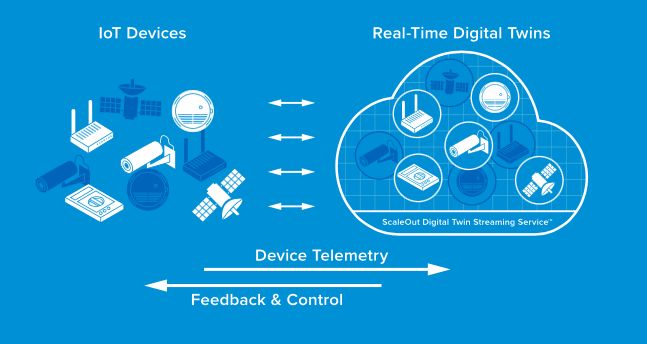
Digital twins offer a simple, intuitive technique for organizing important, dynamically evolving, state information about each individual data source and using that information to enhance the real-time analysis of incoming telemetry
Traditional stream-processing and complex event-processing systems focus on extracting patterns from incoming telemetry, but they can’t track dynamic information about individual data sources. This makes it much more difficult to fully analyze what incoming telemetry is saying. For example, an IoT predictive analytics application attempting to avoid an impending failure in a population of medical freezers must look at more than just trends in temperature readings. It needs to evaluate these readings in the context of each freezer’s operational history, recent maintenance, and current state to get a complete picture of the freezer’s actual condition.
That’s where the power of real-time digital twins comes in. While digital twin models have been used for several years in product life cycle management, their application to stateful stream-processing has only now been made possible by advances in scalable, in-memory computing. Unlike traditional streaming pipelines, like Apache Storm and Flink, real-time digital twins offer a simple, intuitive technique for organizing important, dynamically evolving, state information about each individual data source and using that information to enhance the real-time analysis of incoming telemetry. This enables deeper introspection than previously possible and leads to significantly more effective feedback — all within milliseconds.
Real-time digital twins also provide a powerful means for deploying machine learning (ML) capabilities that track incoming telemetry and look for anomalies that require alerting. By running within digital twins, ML algorithms can be tailored for each type of device and its parameters, and they can run independently and simultaneously for thousands of data sources.
Equally important, the state-tracking provided by real-time digital twins allows immediate, aggregate analytics to be performed every few seconds. Instead of deferring aggregate analytics to batch processing on Spark, real-time digital twins enable important patterns and trends to be quickly spotted, analyzed, and handled. This dramatically improves situational awareness. For example, if a regional power outage takes out a group of medical freezers, precise information about the scope of the outage can be immediately surfaced and the appropriate response implemented.
Real-time digital twins can enhance the ability of any stream-processing application to analyze the dynamic behavior of its data sources and respond fast. Here are just a few examples:
Intelligent, real-time monitoring: fleet tracking, security monitoring, disaster recovery
Financial services: portfolio tracking, wire fraud detection, stock back-testing
Internet of Things (IoT): device tracking for manufacturing, vehicles, fixed and mobile devices
Healthcare: real-time patient monitoring, medical device tracking and alerting
Logistics: real-time inventory reconciliation, manufacturing flow optimization
For more information visit: https://www.scaleoutsoftware.com/products/digital-twin-streaming-service/.